
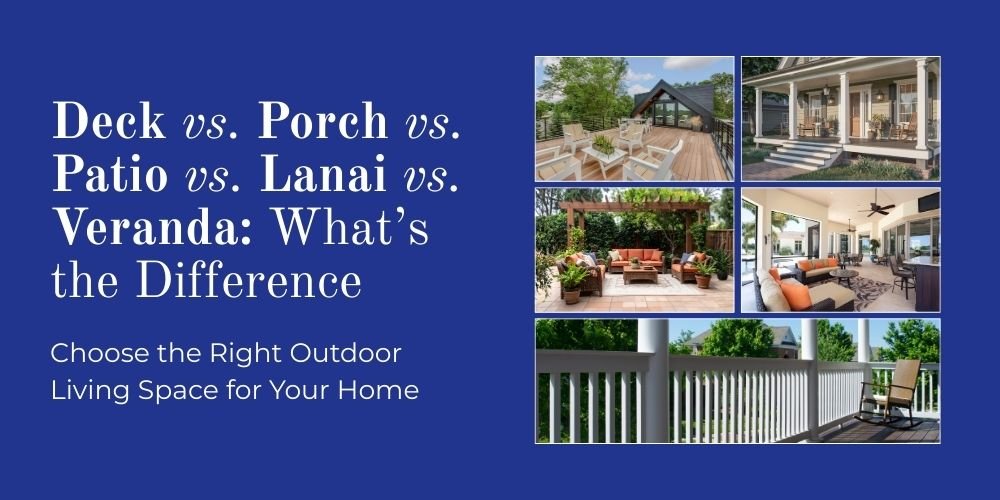
You are standing in your backyard, or maybe scrolling through ideas late at night, and you keep running into the same problem. Everyone calls things different names. A neighbor says they built a deck. A contractor quotes you for a patio. The listing you love online shows a veranda. And somewhere in the middle of it all, you are just trying to figure out what you actually want.
That confusion is real. These words are used interchangeably all the time, even by professionals. A covered patio gets called a porch. A large porch gets labeled a veranda. A flat wooden surface at ground level gets called a deck even when it is not elevated.
You deserve a clear answer. Not a dictionary. Not a list of specs. A real explanation of what each space actually is, how it is built, and which one makes sense for your home, your yard, and the way you want to live outside.
That is exactly what this guide gives you.
Quick comparison
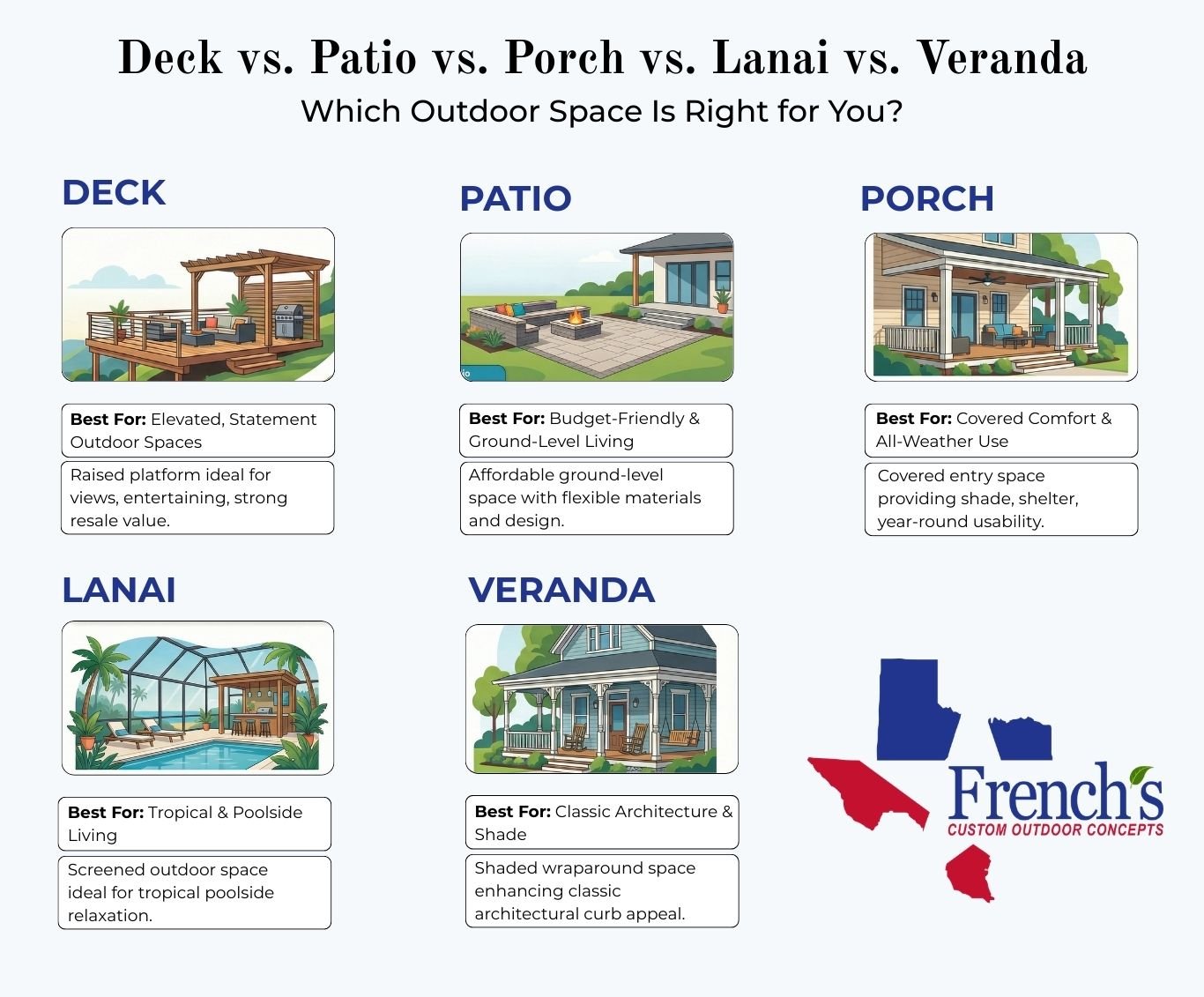
Before we go deeper, here is the full picture at a glance.
| Space | Covered? | Elevated? | Ground level? | Avg. cost/sq ft | Best for |
|---|---|---|---|---|---|
| Deck | Optional | Yes | No | $15–$35 | Views, entertaining |
| Patio | Optional | No | Yes | $8–$20 | Dining, fire pits, budgets |
| Porch | Yes | Slightly | Sometimes | $20–$50 | Year-round outdoor living |
| Lanai | Yes (screened) | No | Yes | $20–$45 | Tropical / humid climates |
| Veranda | Yes | Slightly | Sometimes | $25–$55 | Wraparound coverage, curb appeal |
The Simplest Way to Tell Them Apart
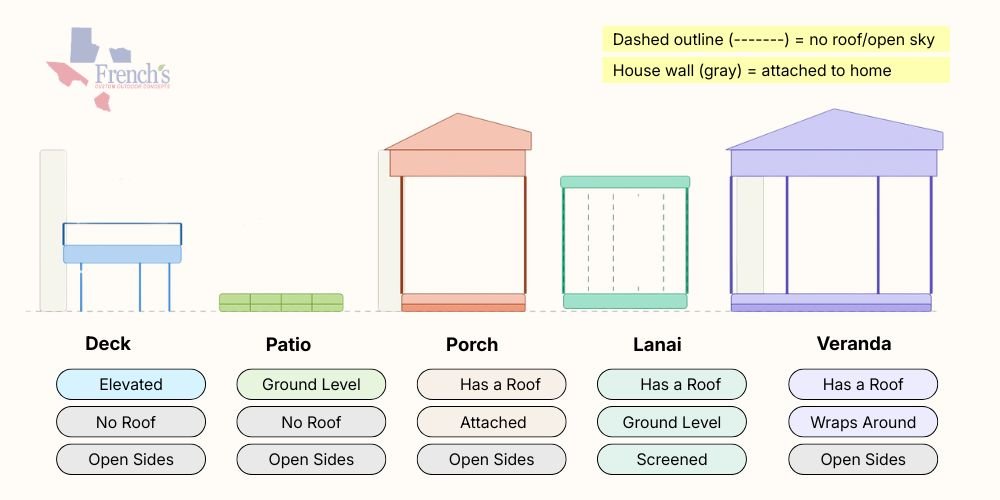
Every outdoor space has one defining feature. One thing that makes it what it is. When you know what that one thing is, the confusion disappears.
| Space | The one thing that defines it |
|---|---|
| Deck | It is elevated. If the surface is raised on a frame above the ground, it is a deck. |
| Patio | It sits on the ground. If it is flat, paved, and at grade level, it is a patio. |
| Porch | It has a permanent roof that is part of the home. No roof, no porch. |
| Lanai | It is screened in. Full screening on the sides is what makes a lanai a lanai. |
| Veranda | It wraps around more than one side of the home. Scale and layout define it. |
| Balcony | It is attached to an upper floor and accessed from inside, not from the yard. |
What Defines Each Outdoor Space?
Every outdoor space can be understood through four simple structural questions: Is it covered? Is it elevated? Is it attached to the home? Is it enclosed? The answers are what truly separate a deck from a porch, or a patio from a lanai. Here’s each space explained once: structure, materials, and what it’s best for.
What Is a Deck?

Picture the back of a home with a raised wooden platform stretching out from the door. That is a deck. It sits on a frame of posts and beams, which lifts it above the ground. It is open to the sky, with no walls and no roof built in.
What makes a deck special is exactly that elevation. It gives you views. It lets you build above a sloped yard where a patio would be impossible. And because it stands on its own structure, it can be customized in almost any direction, such as pergolas, railings, outdoor kitchens, and multiple levels.
Here is something worth knowing. A wooden surface at ground level is not a deck. If it is not elevated, it does not qualify, no matter what material it is made of.

| Materials Used | Pressure-treated lumber or steel for the subframe; natural wood (cedar, redwood), composite, or PVC boards for the surface. |
|---|---|
| Key benefits | Better views from elevation; works on sloped or uneven terrain; customizable with pergolas, railings, and outdoor kitchens; strong resale value. |
| Best for | Homeowners with sloped yards, those wanting elevated views or frequent outdoor entertaining. |
Common confusion: People often call any outdoor wooden surface a deck. If it is not raised on a structural frame, it is not technically a deck. It may be a patio built with wood or composite tile.
Recommended Read: Composite Decking vs Wood Decking
What Is a Patio?
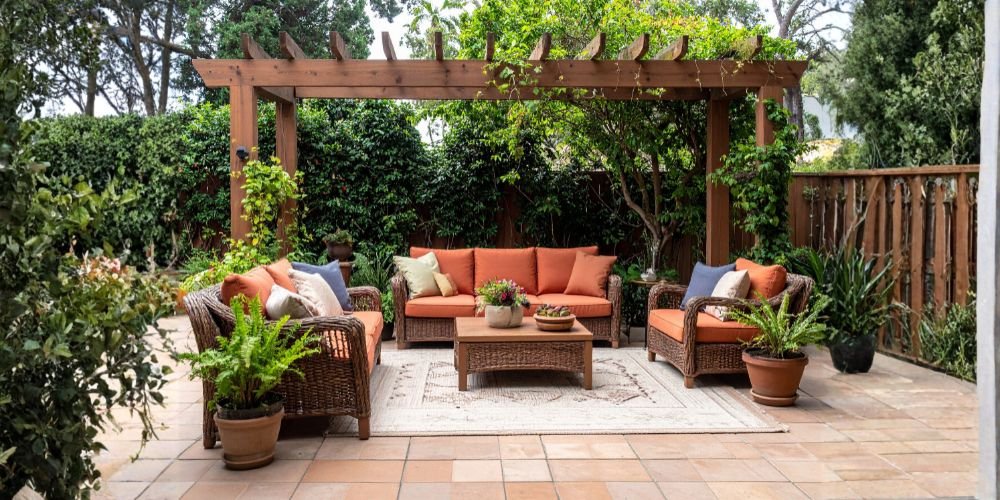
A patio is the most grounded of all five spaces, literally. It sits flat on the earth, paved with hard material, requiring no frame and no posts underneath it. You can attach it to your home or set it anywhere in the yard.
This simplicity is its greatest strength. Patios are the most affordable outdoor space to build, the most flexible in shape and material, and the easiest to modify or expand over time. They do not require a building permit in most areas.
If your yard is flat and your budget has limits, a patio is often the wisest starting point.

| Materials Used | Poured concrete, concrete pavers, natural stone (bluestone, flagstone, travertine), brick, or porcelain tile. |
|---|---|
| Key benefits | Most affordable outdoor structure; no permit usually required; unlimited shapes and materials; ground-level access is great for children, elderly, and pets. |
| Best for | Flat yards, tight budgets, and anyone wanting design flexibility for dining or casual entertaining. |
Common confusion: Adding a pergola or roof cover does not automatically turn a patio into a porch. A porch roof is permanently integrated into the home’s roofline. A pergola is a freestanding addition on top of a patio — the two are structurally different.
What Is a Porch?
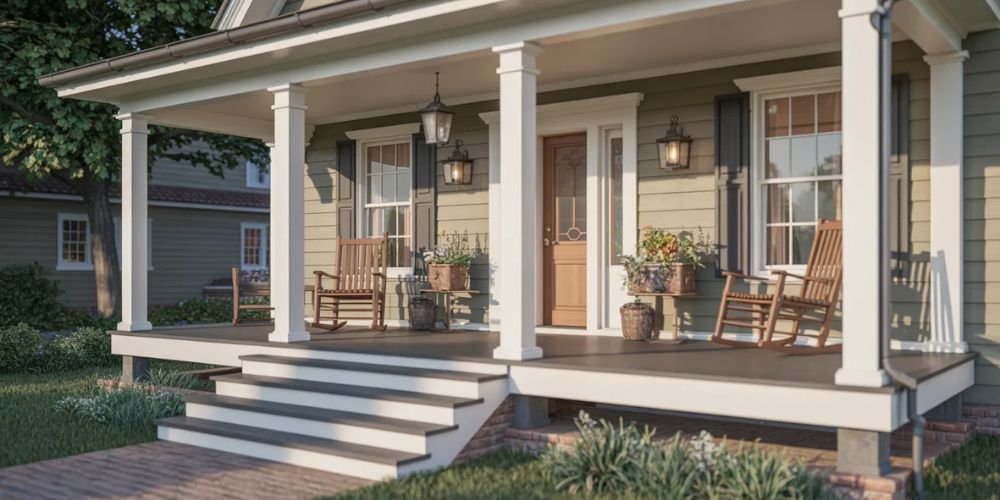
A porch is where your home reaches out to meet the outdoors. Its roof is not a separate structure; it is an extension of the home’s own roofline. That connection is what makes a porch feel so different from a deck or a patio. It is part of the house, not added onto it.
A porch can be open on the sides, screened in to keep insects out, or fully enclosed with glass into a three-season room. Each version gives you a different level of weather protection and comfort.
If you live somewhere with heavy rain, strong sun, or relentless mosquitoes, a porch may be the single most livable outdoor upgrade you can make to your home.

| Materials Used | Wood or composite flooring, structural columns, roof extension matching the home’s roofline, optional screens or glass panels. |
|---|---|
| Key benefits | Weather protection from rain, sun, and wind; screened versions eliminate insects; front porches dramatically boost curb appeal; feels like a true outdoor room. |
| Best for | Humid climates, insect-prone areas, and homeowners who want year-round outdoor usability. |
Common confusion: The most common mix-up is between a porch and a veranda. They are built the same way. The difference is in size and layout. A veranda wraps around more than one side of the home. A porch typically faces one direction.
What Is a Lanai?
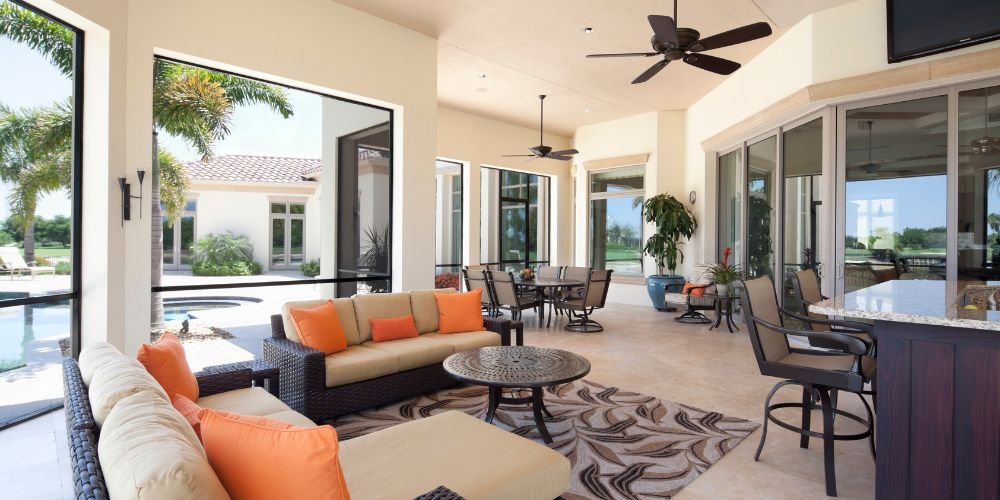
If you have spent time in Florida or Hawaii, you have likely been inside a lanai without knowing its name. It is a covered, screened outdoor space almost always at ground level designed to let you live outside without the bugs.
Think of it as a screened porch that has been built specifically for tropical living. It is often positioned around a pool, letting you move freely between the water and the shaded, insect-free space beside it.
The screens are the defining feature. Without full screening on the sides, it is not a lanai. It becomes a covered patio or an open porch instead.

| Materials Used | Aluminum or wood frames, screened panels (roll-formed or extruded aluminum), and concrete or tile flooring. |
|---|---|
| Key benefits | Bug-free outdoor living year-round; full airflow and natural light; ideal poolside structure; no HVAC costs. |
| Best for | Homeowners in Florida, Hawaii, or subtropical climates who want bug-free, poolside year-round outdoor living. |
Common confusion: Not every covered outdoor space is a lanai. The full screening is what separates a lanai from a covered patio or an open porch. If the sides are open, it does not qualify.
What Is a Veranda?
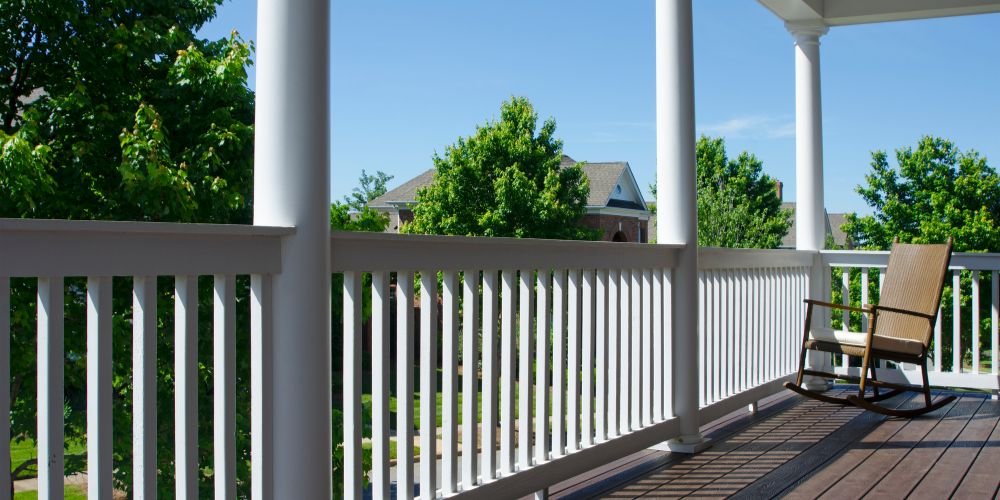
A veranda is what happens when a porch grows to wrap around more than one side of a home. Same permanent roof. Same open sides. Same columns. But instead of facing one direction, it extends along the front and sides or sometimes all the way around.
This wraparound quality gives a veranda something a porch cannot offer: shade at any hour of the day, no matter where the sun is sitting. It is common in the American South and in homes with colonial or Victorian architecture.
You may also see it spelled verandah that is the Australian and British spelling of the same structure. The building is identical. Only the spelling changes.

| Materials Used | Evenly spaced wood or metal columns, roof matching the home’s architecture, wood or tile flooring. |
|---|---|
| Key benefits | Wraparound shade across multiple sides; striking curb appeal; suited to traditional, colonial, and Victorian-style homes. |
| Best for | Hot, sunny climates and homes with traditional or colonial architecture where wraparound shade is a priority. |
Common confusion: Porch and veranda are often used as synonyms, even by contractors. In practice, the difference is in the layout. If it wraps around multiple sides of the home, it is a veranda. If it faces one direction, it is a porch.
What Is a Balcony?
A balcony belongs to a different category than the other five. While decks, patios, porches, lanais, and verandas are all ground-level or near-ground-level spaces, a balcony projects from the wall of an upper floor.
You access it from inside through a door or sliding glass panel. It is typically smaller than a deck, designed for one or two people to stand or sit rather than for entertaining a group. In apartment buildings and multi-story homes, it is the primary way to get any outdoor space at all.
The most common confusion is between a balcony and a deck. Both can be made of wood or composite. Both can have railings. The difference is location. A balcony is always elevated and accessed from an upper room. A deck sits at or near ground level and is accessed from the yard or back door.
| Materials Used | Steel or concrete structure for the floor; wood, composite, or tile surface; metal or glass railings. |
|---|---|
| Key benefits | Provides outdoor access from upper floors; private retreat with elevated views; works in apartment buildings and multi-story homes where ground space is limited. |
| Best for | Upper-floor living spaces, city homes, and apartments where a ground-level outdoor structure is not possible. |
Common confusion: Balconies and decks look similar in photos — both are elevated platforms with railings. The difference is access. If you walk out of an upper-floor room, it is a balcony. If you step out from the back door at ground level, it is a deck.
Side-by-Side: How Each Pairing Differs
Sometimes a single comparison is all you need. Here is every key pairing answered in one line.
Deck vs. Patio:
A deck is elevated on a frame. A patio is flat on the ground. Decks handle slopes; patios need level land.
Deck vs. Porch:
A porch has a permanent roof tied to the home. A deck is open to the sky. A porch is architecture; a deck is an addition.
Porch vs. Patio:
A porch is covered and part of the house. A patio is open-air and independent. More formal versus more casual.
Lanai vs. Porch:
Both are covered and attached. A lanai is always screened and ground-level. A porch is open-sided by default.
Porch vs. Veranda:
Both share a roof and columns. A veranda wraps around multiple sides. A porch faces one direction.
Deck vs. Balcony:
Both are elevated platforms with railings. A balcony is accessed from an upper-floor room. A deck is accessed from the yard.
Covered Patio vs. Porch:
A porch roof is built into the home’s roofline. A covered patio has a separate structure added on top. Same function, different construction.
Which One Is Actually Right for You?
This is the question that brought you here. And it deserves a direct answer.
Choose a deck: if your yard slopes, if you want elevated views, or if resale value matters to you. Composite decks return roughly 90–94% of their cost when you sell.
Choose a patio: if your yard is flat, your budget is tight, or you want easy ground-level access. It is the most flexible and most affordable place to start.
Choose a porch: if your climate is rainy, humid, or filled with insects, and you want to be outside regardless of the weather. It is the closest thing to an outdoor room.
Choose a lanai: if you are in Florida, Hawaii, or a subtropical climate and want bug-free outdoor living year-round, especially around a pool.
Choose a veranda: if your home has traditional or colonial architecture, and you want wraparound shade that works at any time of day.
Choose a balcony: if you are in a multi-story home or apartment and want any outdoor access at all from an upper floor.
And if you are still unsure, many of the best outdoor spaces combine more than one. A deck for entertaining. A patio below for dining. A screened porch for evenings without the bugs. The right answer is the one that fits how you actually want to spend your time outside.
Frequently asked questions
What is the main difference between a deck and a patio?
A deck is elevated off the ground on a structural frame. A patio sits flat on the ground. Decks cost more to build but offer better views and typically return more value at resale.
Is a porch the same as a deck?
No. A porch always has a permanent roof that is part of the home’s roofline. A deck is open to the sky and is an addition to the home, not part of its original architecture.
What is cheaper to build, a deck or a patio?
Patios are cheaper. A basic concrete or paver patio typically runs $8–$20 per square foot. A wood or composite deck runs $15–$35 per square foot. However, decks generally return more at resale.
What is the difference between a lanai and a porch?
Both are covered and attached to the home. A lanai is always ground-level and fully screened on the sides. A porch is open-sided by default and can be slightly elevated. Lanais are most common in tropical climates like Florida and Hawaii.
Can a patio be covered?
Yes. Pergolas, shade sails, and awnings are all common on patios. A fully roofed patio begins to look like a porch, but it is technically still a patio if it stays at ground level and the roof is not connected to the home’s roofline.
What is the difference between a balcony and a deck?
A balcony projects from an upper floor and is accessed from inside through a door. A deck is at or near ground level and is accessed from the yard or back door. Both can be elevated, but the access point and floor level are different.
Is a verandah the same as a veranda?
Yes — same structure, different spelling. Verandah is the Australian and British spelling. Veranda is the American spelling. The building itself is identical in both cases.
Final Thoughts
You came here with a question. Maybe it was a simple one. Maybe it felt more complicated than it should.
What you now know is this: every outdoor space has one defining characteristic. A deck is elevated. A patio is grounded. A porch has a roof that belongs to the house. A lanai is screened. A veranda wraps around. A balcony reaches out from an upper floor.
When you understand that, the labels stop being confusing. They start being useful.
The right outdoor space is the one that fits your yard, your climate, your budget, and how you want to live. Start there, and everything else will follow.
If you’re planning a rooftop deck instead of a traditional backyard deck, choosing the right surface is even more important. Explore our guide to the best roof decking materials to compare the top options for durability, maintenance, and rooftop performance.
Ready to build your outdoor space in San Antonio? Contact French’s Custom Outdoor Concepts for a free consultation.