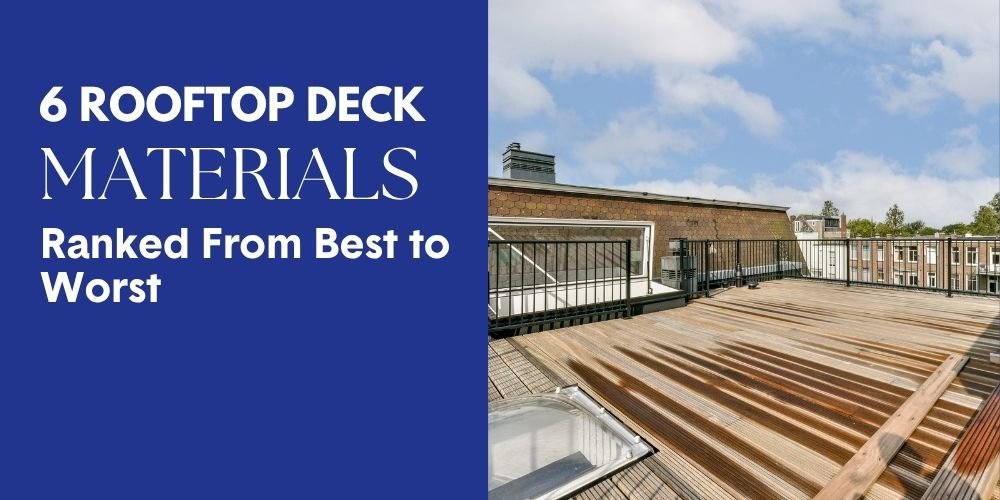
Choosing the right roof decking material isn’t as simple as picking the one that looks best. A rooftop deck deals with constant sun exposure, standing water, temperature changes, and structural weight limits that traditional backyard decks rarely face. The wrong material can lead to higher maintenance, faster wear, or unnecessary repair costs, while the right one can perform reliably for decades.
Whether you’re building a new rooftop deck or upgrading an existing one, understanding the strengths and limitations of each material is essential. In this guide, we’ll compare the six best roof decking materials, explain where each one performs best, and help you choose the right option based on durability, maintenance, budget, and long-term performance.
Why Roof Decking Material Is a Completely Different Decision
What works on a backyard deck doesn’t automatically survive a rooftop. A flat roof offers zero shade, continuous UV exposure, wind uplift, and surface temperatures that can run 40–50°F hotter than the ambient air on a summer afternoon. The wrong roof decking material won’t just look bad early; it can compromise your waterproof membrane and trigger repairs far more expensive than the original deck build.
What Makes a Rooftop Environment So Different
Rooftops punish materials in ways ground-level decks never do:
Full-day UV exposure burns through synthetic UV inhibitors faster than any shaded backyard install. Heat buildup accelerates thermal expansion cycles in every board, stressing fasteners and board ends with each temperature swing. Wind uplift works against fastening systems in ways that don’t apply at ground level. Drainage intolerance means water sitting under your deck is sitting directly against the membrane. And structural weight limits mean every pound of dead load your roof decking material adds is a pound taken away from people, furniture, and actual use.
Most residential rooftops are engineered to a minimum of 40 PSF live load per IBC Section 1607.12. Your decking system’s dead load framing, surface material, and fasteners consume that budget before anyone steps on the deck. Choose a heavy roof decking material without confirming structural capacity first, and you’ve already made the biggest mistake.
Best Roof Decking Materials for Flat Roofs
Flat roofs create opportunities that sloped roofs simply can’t. They can be transformed into outdoor lounges, rooftop gardens, dining areas, or entertainment spaces—but only if the decking material is designed to perform in that environment.
Unlike a traditional backyard deck, a flat roof must support foot traffic while protecting the waterproofing system beneath it. That means the best material isn’t always the strongest or the most expensive. It needs to balance durability, weight, drainage, and long-term maintenance.
Composite Decking
Composite decking is one of the most popular choices for residential flat roof decks because it combines the appearance of natural wood with low maintenance. It won’t splinter, rot, or require annual staining, making it a practical option for homeowners who want a rooftop space they can enjoy without constant upkeep.
Porcelain Pavers
For modern rooftop patios, porcelain pavers offer outstanding durability and weather resistance. They’re commonly installed on pedestal systems, allowing rainwater to drain beneath the surface while providing access to the roof membrane if maintenance is ever required. Their clean, contemporary appearance also makes them a favorite for luxury rooftop designs.
PVC Decking
When structural weight is a concern, PVC decking is worth considering. It’s lighter than many traditional decking materials, highly resistant to moisture, and performs well in climates with frequent rain or humidity. For older buildings or rooftops with stricter load limitations, PVC can be an effective solution.
Hardwood Decking
Premium hardwoods such as Ipe and Cumaru remain an excellent option for homeowners who want a natural wood finish with exceptional durability. These dense hardwoods naturally resist moisture, insects, and wear, making them suitable for rooftop environments when the structure is engineered to support the additional weight.
Which Material Works Best?
There isn’t one roof decking material that’s right for every flat roof. A rooftop designed for everyday entertaining may benefit from low-maintenance composite decking, while a luxury rooftop terrace might justify the investment in hardwood or porcelain pavers. The best choice depends on your roof’s structural capacity, your budget, your local climate, and how you plan to use the space over the next 20 to 30 years.
How Different Roof Decking Materials Perform on Rooftops
Not every decking material responds the same way to rooftop conditions. Factors such as UV exposure, thermal movement, moisture resistance, structural weight, and maintenance requirements can significantly influence long-term performance. Below is a closer look at the most common roof decking materials and how they compare in real-world rooftop environments.
1. Hardwood Decking
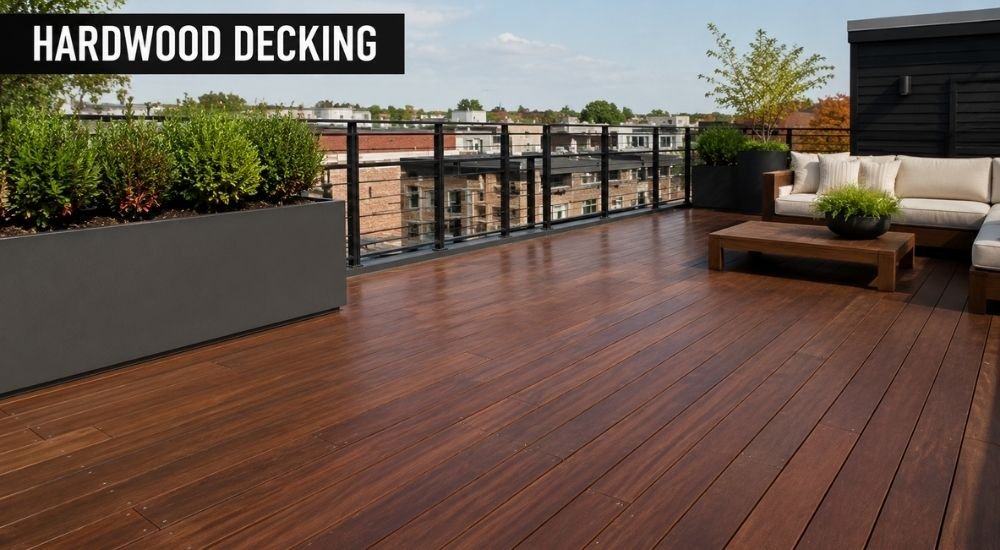
Rooftop Verdict: The strongest long-term performer where weight is supported.
Dense tropical hardwoods- Ipe, Cumaru, Garapa, Jatoba, Machiche are built by nature for punishment. Their fiber density resists moisture absorption, rot, insects, and UV degradation without relying on factory-added inhibitors. Ipe specifically achieves a Class A fire rating (same as concrete and steel), which matters in urban and code-restricted areas. Hardwood can be left to silver naturally with zero structural impact, or maintained with periodic UV oil to hold its original color. Either way, it doesn’t check, split, or cup the way synthetics do under rooftop-level cycling.
- Lifespan: 40+ years on the rooftop
- Maintenance: Low optional UV oil, or let it weather
- Weight: Heavy; confirm structural load first
- Best for: High-end residential, urban rooftops, commercial spaces
2. Porcelain Pavers (Pedestal System)
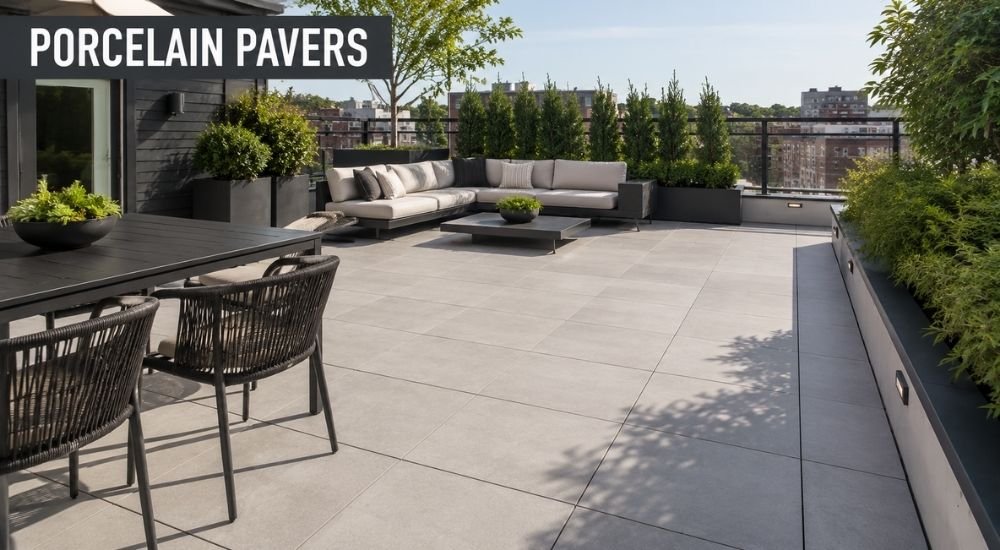
Rooftop Verdict: Best all-around choice when weight is a concern.
Porcelain on an adjustable pedestal system is the dominant choice for modern rooftop decks and for clear reasons. It doesn’t absorb water, doesn’t fade from UV, doesn’t react to freeze-thaw cycling, and needs nothing beyond occasional cleaning. The pedestal system creates an air gap that protects the membrane and keeps drainage flowing underneath. It also allows the deck surface to be lifted for membrane inspection without demolishing, building a significant long-term advantage.
- Lifespan: 30–50+ years
- Maintenance: Cleaning only
- Weight: Moderate to heavy; verify load
- Best for: Contemporary rooftop patios, urban condos, commercial event spaces
3. Thermally Modified Wood Decking
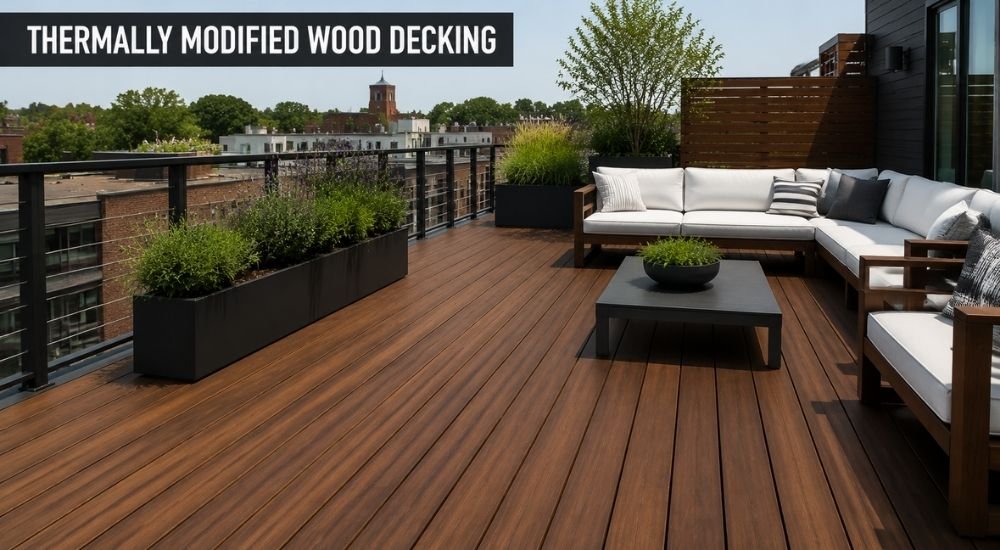
Rooftop Verdict: Real wood performance without the hardwood price.
Thermally modified wood is heat-treated to change its cellular structure, dramatically improving dimensional stability, rot resistance, and moisture rejection without chemicals. On a rooftop, it outperforms untreated softwoods and pressure-treated lumber by a significant margin, cycling through temperature extremes with far less movement. Species like thermally modified Hem-Fir offer a clean contemporary look similar to cedar with genuinely better durability at a mid-range price point.
- Lifespan: 25–30+ years rooftop
- Maintenance: Cleaning plus optional UV oil
- Weight: Lighter than tropical hardwoods
- Best for: Homeowners who want real wood aesthetics at a sustainable price
4. Composite Decking
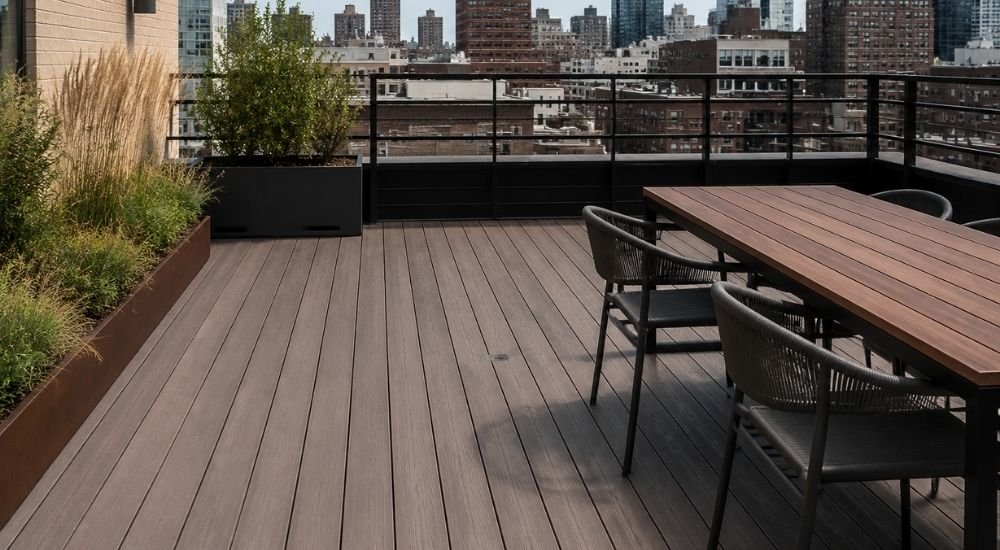
Rooftop Verdict: Works in sheltered or partially shaded rooftop environments risky on fully exposed flat rooftops.
Modern capped composite from brands like Trex and TimberTech is genuinely excellent on ground-level and partially sheltered decks. The rooftop story is more complicated. Under continuous UV loading on a fully exposed flat roof, the polymer cap layer degrades faster than manufacturer warranties written for typical residential exposures anticipate. Dark composite boards can reach surface temperatures in direct sun that accelerate thermal expansion stress and surface degradation. Expect 15–20 years rather than the 25–30 year ground-level lifespan. If composite is the choice, go lighter on board color, maximize ventilation beneath the boards, and read the warranty UV exclusions carefully.
- Lifespan: 15–25 years (rooftop, full exposure)
- Maintenance: Low cleaning only
- Weight: Moderate
- Best for: Rooftops with pergola shade coverage or buildings where structural load limits rule out hardwood
5. PVC Decking
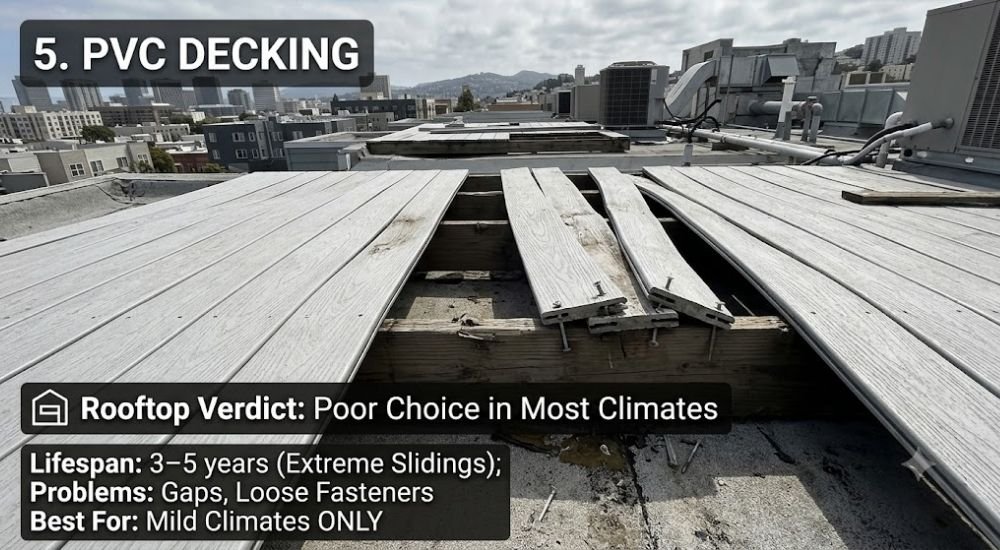
Rooftop Verdict: Poor choice in most climates.
PVC’s strength is no wood fiber- it becomes an exceptional moisture-resistance liability on a rooftop. PVC expands and contracts more aggressively with temperature changes than any other common roof decking material. On a rooftop with significant day-to-night temperature swings, boards expand against each other or leave visible gaps at miters and board ends. Over a few years, the fastener connections work loose. Most experienced rooftop contractors steer clients away from PVC as a roof decking material, even when they happily use it on ground-level coastal installs. Mild climates with minimal temperature variation are the only scenario where PVC on a rooftop makes sense.
- Lifespan: Highly variable; problems can appear in 3–5 years in swing climates
- Maintenance: Very low when it holds
- Weight: Lightest common option
- Best for: Budget and weight-constrained builds in mild coastal climates only
6. Pressure-Treated Lumber
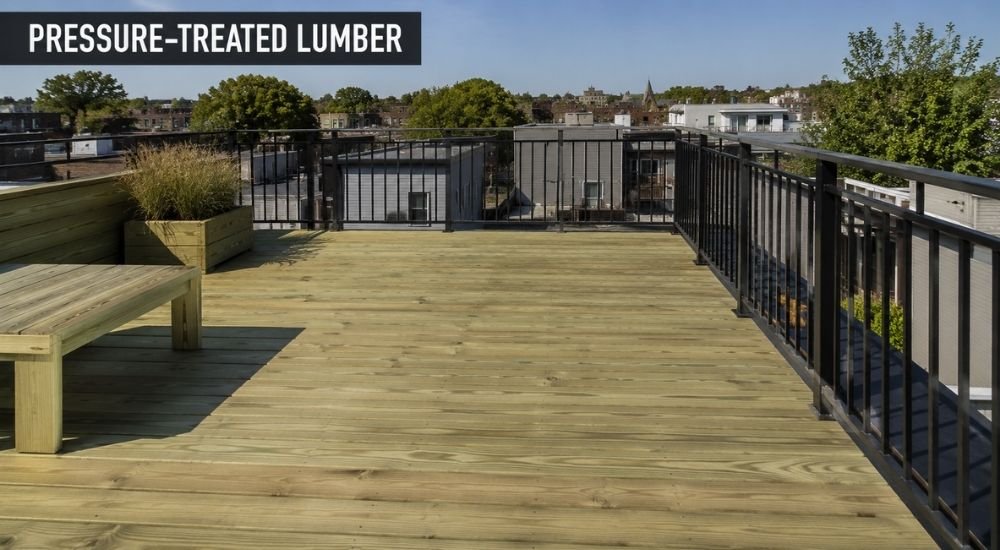
Rooftop Verdict: Last resort only with clear expectations on lifespan.
PT lumber is the most affordable roof decking material and the least appropriate for a fully exposed rooftop. Chemical treatment resists rot and insects but does nothing for UV degradation, checking, cupping, or warping, all of which accelerate dramatically on an unshaded roof. Annual sealing or staining isn’t optional; without it, visible deterioration begins within a season or two. Factor in the recurring maintenance costs and the realistic 10–15-year lifespan before significant intervention, and the upfront savings erode quickly.
- Lifespan: 10–15 years with consistent maintenance
- Maintenance: High annual sealing is non-negotiable
- Weight: Moderate
- Best for: Short-term or budget-constrained builds where the replacement timeline is accepted
Roof Decking Material Options: Which Type Is Right for Your Roof?
Selecting the right roof decking material isn’t simply about choosing the strongest or most attractive option. Every rooftop has different structural requirements, weather exposure, maintenance expectations, and design goals. Understanding the available roof decking material options can help you narrow your choices and invest in a system that performs well for years.
Below is a quick comparison of the most common roof decking materials and where each one performs best.
| Roof Decking Material | Best For | Key Advantages | Considerations |
| Hardwood (Ipe & Cumaru) | Premium residential roof decks | Exceptional durability, natural beauty, long lifespan | Higher initial investment and periodic maintenance |
| Composite Decking | Outdoor living spaces with minimal maintenance | Resists fading, moisture, insects, and splintering | Costs more upfront than pressure-treated lumber |
| PVC Decking | Lightweight rooftop structures | Extremely moisture resistant and lightweight | Can expand and contract more in extreme temperatures |
| Pressure-Treated Lumber | Budget-conscious homeowners | Affordable and widely available | Requires regular sealing and maintenance |
| Thermally Modified Wood | Homeowners wanting a natural wood appearance | Improved stability and moisture resistance | Premium pricing compared to traditional lumber |
| Porcelain Paver Systems | Modern rooftop patios and commercial terraces | Durable, slip resistant, and easy to maintain | Requires a properly designed pedestal support system |
Which Roof Decking Material Option Should You Choose?
If you’re designing a rooftop space for everyday relaxation, composite decking offers one of the best balances of durability, appearance, and long-term maintenance. Homeowners seeking a premium natural finish often choose hardwood decking, while PVC decking is an excellent solution for projects where reducing structural weight is a priority. For commercial rooftop terraces or contemporary outdoor spaces, porcelain paver systems provide exceptional durability with very little maintenance.
Rather than choosing a roof decking material based only on price, compare each option based on your roof’s structural capacity, climate, maintenance expectations, and how you plan to use the space. A material that performs well on one rooftop may not be the ideal choice for another.
Professional Insight: The best roof decking material is the one that matches your project’s structural requirements and long-term performance goals—not simply the most expensive or most popular option.
Which Roof Decking Material Is Best for Your Project?
The best roof decking material depends on how you plan to use the space, your maintenance preferences, and the building’s structural limitations.
Best Overall Roof Decking Material
Hardwood decking, particularly species like Ipe and Cumaru, remains one of the strongest long-term performers for rooftop environments. Its natural resistance to moisture, insects, UV exposure, and wear allows it to perform exceptionally well even under demanding rooftop conditions.
Best Low-Maintenance Option
Porcelain pavers on pedestal systems require little more than occasional cleaning. They resist fading, moisture absorption, and freeze-thaw damage while allowing easy access to the roofing membrane beneath.
Best Budget-Friendly Option
Pressure-treated lumber remains the most affordable choice for homeowners working with a limited budget. While it requires regular maintenance, it can provide a functional rooftop surface at a lower upfront cost.
Best Lightweight Option
PVC decking is one of the lightest decking materials available, making it attractive for structures with stricter load limitations. However, thermal expansion should be carefully considered in climates with significant temperature swings.
Best Natural Wood Alternative
Thermally modified wood provides the appearance of real wood while offering greater dimensional stability and moisture resistance than many untreated species.
Best for Commercial Rooftops
Porcelain pavers are frequently used on commercial rooftop terraces due to their durability, minimal maintenance requirements, and compatibility with pedestal systems.
Roof Decking Material Comparison Table
| Material | Rooftop Lifespan | Maintenance | Weight Impact | Fire Rating | Rooftop Suitability |
| Hardwood (Ipe, Cumaru) | 40+ years | Low–Moderate | Heavy | Class A | ⭐⭐⭐⭐⭐ Excellent |
| Porcelain Pavers | 30–50+ years | Very Low | Moderate–Heavy | Non-combustible | ⭐⭐⭐⭐⭐ Excellent |
| Thermally Modified Wood | 25–30 years | Low | Moderate | Moderate | ⭐⭐⭐⭐ Very Good |
| Composite Decking | 15–25 years | Low | Moderate | Variable | ⭐⭐⭐ Good (sheltered) |
| PVC Decking | 3–15 years | Very Low | Light | Variable | ⭐⭐ Poor |
| Pressure-Treated Lumber | 10–15 years | High | Moderate | Poor | ⭐ Last Resort |
Best Roof Decking Material by Climate
Climate plays a major role in determining how well a decking material performs over time. A product that performs exceptionally well in one region may experience accelerated wear in another.
Hot and Sunny Climates
In areas with intense sun exposure and high rooftop temperatures, hardwood decking and porcelain pavers often provide the best long-term performance. Both materials handle UV exposure better than many synthetic alternatives and experience less visible degradation over time.
Coastal Environments
Coastal regions expose decking materials to moisture, humidity, and salt-laden air. PVC decking and porcelain pavers are commonly selected because they resist moisture absorption and require minimal maintenance.
Snow and Freeze-Thaw Regions
Repeated freeze-thaw cycles can be particularly demanding on rooftop surfaces. Porcelain pavers and high-density hardwoods generally perform well in these environments due to their durability and resistance to moisture-related damage.
High-Wind Areas
In regions prone to strong winds, heavier materials such as hardwood decking and properly installed pedestal paver systems often provide greater stability than lightweight alternatives.
4 Roof Deck Material Mistakes That Are Easily Avoided
1: Skipping the Structural Assessment
Every roof decking material decision on a rooftop is also a load calculation decision. Get a licensed structural engineer’s sign-off before specifying any surface material, especially concrete pavers, stone, or hardwood.
2: Ignoring Board Color on Composite and PVC
Dark boards absorb significantly more heat on a rooftop. In San Antonio’s climate, where summers push roof surface temperatures well above 100°F, lighter board colors are a functional decision, not just aesthetic.
3: Building Over an Aging Membrane
A new deck surface over an old or deteriorating roof membrane creates a future demolition problem. When the membrane needs repair, you’ll tear out the deck to get to it. Inspect and repair the membrane before building anything over it.
4: Skipping Expansion Gap Spacing
Every roof decking material requires specific gap spacing for thermal movement and drainage. On a rooftop where temperature swings are more severe than at ground level, err toward the wider end of the manufacturer’s recommended spacing range.
Conclusion
Choosing the right roof decking material has a direct impact on the lifespan, maintenance requirements, and long-term performance of your rooftop deck. While hardwood decking and porcelain pavers typically deliver the best results in demanding rooftop environments, the right choice ultimately depends on your structure, budget, climate, and how you plan to use the space.
A successful rooftop deck starts with more than just selecting materials. Structural capacity, waterproofing, drainage, and proper installation all play a critical role in creating a rooftop space that performs reliably for years to come. If you’re still in the planning stage, our guide on how to build a rooftop deck walks through the key steps involved in designing and constructing a rooftop deck the right way.
At French’s Custom Outdoor Concepts, we specialize in creating custom outdoor living spaces that are built for long-term performance. Whether you’re exploring material options or planning a complete rooftop deck project, our team can help you make informed decisions that maximize both durability and value.