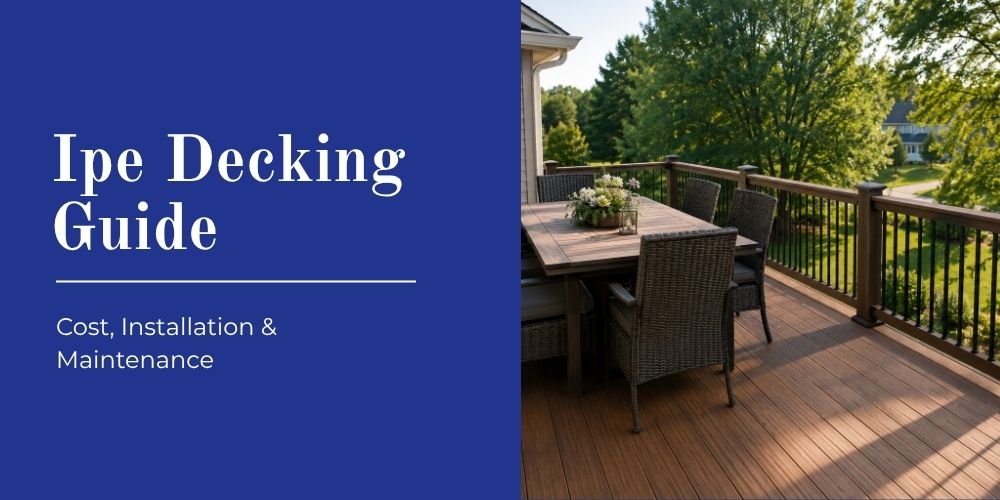
Ipe (pronounced ee-pay) is the benchmark for premium wood decking — and also one of the most misunderstood materials on the market. Most content about ipe decking is written either to sell it to you or to talk you out of it in favor of composite. This guide does neither. It’s everything you actually need to know before you buy: what ipe wood decking is, what it costs in 2026, how it’s installed and maintained, how it compares to the alternatives, and how to source it responsibly.
What Is Ipe Decking?
Ipe is a dense tropical hardwood harvested primarily from Central and South America, most commonly Brazil. Botanically, it comes from the Tabebuia and Handroanthus genera within the Bignoniaceae family — trees that can grow over 100 feet tall with trunks clear of branches for 60 feet or more, which is part of why long, knot-free deck boards are possible in the first place.
In the trade, ipe wood decking goes by several names depending on who’s selling it: Brazilian Walnut, Ironwood, Pau Lope, Diamond Decking, and occasionally Amapa or Tabebuia. It’s all the same family of extremely hard, naturally decay-resistant hardwood sold under the “ipe” name.
It’s become the standard for premium hardwood decking that Ipe buyers compare everything else against, for one simple reason: nothing else in the wood category comes close to its combination of hardness, natural rot resistance, and lifespan. You’ll find Ipe decks on backyard renovations and on major public boardwalks alike, largely because they hold up to decades of weather with very little intervention.
Quick facts:
|
How much does Ipe Decking Cost? (2026 Pricing)
This is where most Ipe content gets vague. Suppliers tend to quote “premium pricing” without numbers, and composite brands tend to cherry-pick the highest Ipe price they can find to make their own product look cheap by comparison. Here’s a straight, current comparison.
| Material | Typical Installed Cost (per sq. ft.) | Expected Lifespan | Est. Cost per Year of Use |
| Pressure-Treated Pine | $15 – $25 | 15–20 years | $1.00 – $1.50 |
| Cedar | $20 – $30 | 15–20 years | $1.30 – $1.80 |
| Composite (mid-range) | $25 – $40 | 25–30 years | $1.00 – $1.40 |
| Ipe Hardwood | $30 – $45 | 40–75 years | $0.55 – $0.85 |
Pricing reflects material plus typical professional installation as of mid-2026 and will vary by region, board profile, and fastening method. Ipe pricing has actually softened relative to composite and softwood over the past two years, while composite and cedar costs have continued to climb.
The pattern that matters here: Ipe has the highest upfront cost but the lowest cost per year of ownership of any material on this list, once you stretch the math across its actual lifespan. A pressure-treated deck you replace twice will likely cost more, over 40 years, than one Ipe deck installed once.
That said, if you’re not planning to stay in the home for 10+ years, or your budget genuinely can’t absorb the upfront cost, that long-term math doesn’t help you today. It’s a real trade-off, not a marketing point.
Pros and Cons: Is Ipe Decking Right for You?
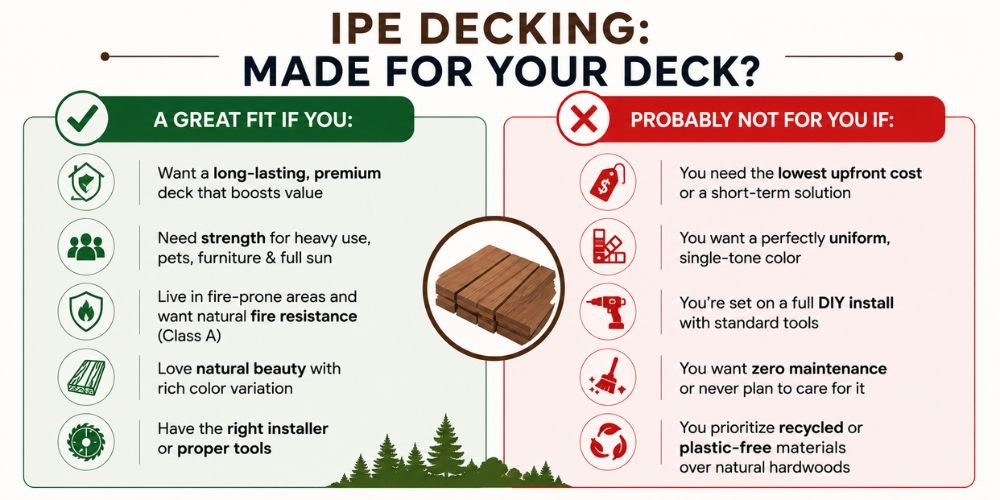
Ipe is a strong fit if you:
- Plan to stay in your home long-term, or want to maximize resale value with a premium, low-maintenance material
- Want a deck that can handle heavy foot traffic, pets, furniture, and full sun exposure without warping or splintering
- Are building somewhere with real fire exposure risk (WUI zones, dry climates) and want a Class A-rated natural material
- Don’t mind — or actually prefer — natural color variation over a uniform, manufactured look
- Are hiring an experienced installer, or are comfortable using carbide-tipped blades and pre-drilling
Ipe is probably not the right choice if you:
- Need the lowest possible upfront cost and won’t be in the home long enough to benefit from ipe’s lifespan
- Want a completely uniform, single-tone color with zero natural variation
- Are set on a fully DIY install with standard tools — ipe’s density makes this a genuinely harder project than softwood or composite
- Want a zero-maintenance, walk-away material — ipe is low maintenance, not no maintenance, if you want to preserve its color
- Are prioritizing recycled-content or plastic-free sustainability messaging over natural hardwood sourcing (worth comparing against thermally modified wood or FSC-certified species instead)
If you fall into that second list, that’s a legitimate reason to look at thermally modified wood, a quality composite, or another hardwood species — worth saying plainly rather than trying to talk you out of your own project.
Ipe Deck Installation: What It Actually Takes
Ipe’s density is a selling point structurally and a real challenge on install day. If you’re hiring a contractor or scoping a DIY project, here’s what actually goes into it:
Tools: Standard blades dull quickly on ipe. Installers use carbide-tipped saw blades and drill bits rated for hardwood, and every fastener location needs to be pre-drilled ipe is dense enough to split or snap standard screws if you drive them without a pilot hole.
Acclimation: Ipe should sit on-site for 2–3 weeks before installation so it can adjust to local humidity. Skipping this step is one of the most common causes of end-checking (small cracks at board ends) later on.
Fastening systems: Two main approaches:
- Face-screwing with color-matched, ejector-style hardwood screws — visible but simple and durable.
- Hidden/concealed clip systems — no visible fasteners on the surface, a cleaner look, but they add cost and require precise spacing.
Spacing and ventilation: Proper gapping between boards and adequate ground clearance beneath the deck (ideally 18 inches or more) are what prevent cupping and trapped moisture this is a design and installation issue, not a flaw in the wood itself.
Sealing cut ends: Any field cuts should be sealed with an end-grain sealer before installation to reduce moisture uptake at the cut and further guard against checking.
Because of all this, ipe decking is a well-understood project for experienced professional installers, but a genuinely harder one for a first-time DIYer working with standard tools. Budget more time per board than you would with composite or softwood.
How to Clean and Maintain an Ipe Deck
Ipe’s maintenance needs are genuinely lower than pressure-treated wood or cedar, but “low maintenance” still means some maintenance if you want to keep it looking new. Here’s what that actually involves.
Routine Cleaning (2–4 Times a Year, More in High-Pollen or Coastal Areas):
- Sweep off loose debris, leaves, and dirt.
- Wash with a mix of mild soap (or a wood-safe deck cleaner) and water, using a stiff-bristle broom (avoid wire brushes, which can damage the surface).
- Rinse thoroughly with a garden hose. A light power wash on a low setting is fine; avoid high-pressure settings that can gouge the wood.
- Let the deck dry fully before applying any finish.
If You Want to Preserve the Natural Brown Color:
- Apply a UV-protectant, oil-based hardwood finish (Penofin Hardwood Oil is a common choice for Ipe) roughly once a year, or as the color starts to fade.
- Clean and lightly sand any scratched or gouged areas before reapplying oil. Ipe can be sanded and refinished, unlike composite.
If You’re Fine with it Weathering to Gray:
- Skip the oil entirely. Ipe left untreated will weather to a silvery-gray patina over 12–18 months and then hold that look with minimal further change: just routine cleaning, no refinishing needed.
Stains and Mildew:
- Because Ipe is dense and low-porosity, mildew and algae sit on the surface rather than penetrating it, and typically lift off with a standard deck cleaner and a scrub brush. Avoid bleach-based cleaners, which can discolor the wood unevenly.
How Ipe Weathers Over Time
Whether to oil your deck or let it weather naturally is entirely a style preference. Both are legitimate, low-maintenance paths.
- Oiled: Keeps the rich brown-to-chocolate tones close to the original color. Requires annual reapplication of a UV-protectant oil.
- Weathered: Fades to a driftwood-gray patina within the first year or two, then stays largely stable. No oiling required, just periodic cleaning.
Either way, the wood’s structural performance doesn’t change. Weathering is cosmetic; it doesn’t reduce Ipe’s density, hardness, or resistance to rot and insects.
Ipe vs. Other Decking Materials (Quick Comparison)
| Ipe | Composite | Cedar | Pressure-Treated Pine | |
| Lifespan | 40–75 yrs | 25–30 yrs | 15–20 yrs | 15–20 yrs |
| Maintenance | Low (annual oil optional) | Very low | Moderate | Moderate–High |
| Upfront Cost | High | Moderate–High | Moderate | Low |
| Fire Rating | Class A | Varies by brand | Not fire-rated | Not fire-rated |
| Look | Natural variation | Uniform, manufactured | Natural, softer grain | Basic, requires staining |
| DIY-Friendly | Lower (needs specialty tools) | High | High | High |
If your priority is the lowest possible maintenance with a manufactured look, composite is a reasonable alternative. If you want real wood performance with a much longer lifespan, Ipe remains the strongest option in this table.
If you’re specifically weighing options for a rooftop deck, see our full breakdown of the best roof decking materials.
Sourcing & Sustainability
Ipe can be a genuinely sustainable choice — but only if you buy from a supplier who sources responsibly, and that’s worth vetting rather than taking on faith.
Certification to look for: FSC (Forest Stewardship Council) certification, an independent, third-party verified standard confirming timber comes from responsibly managed forests, or documented sustainable-yield forestry programs.
CITES Appendix II: As of late 2024, ipe’s trade genera (Handroanthus, Tabebuia, and Roseodendron) were added to CITES Appendix II, meaning international shipments now require an export permit confirming legal, non-detrimental harvest — a regulatory change the U.S. Fish & Wildlife Service has been tracking as it rolls out. It’s not a ban and doesn’t affect decks already installed, but it has added permitting steps at export, part of why supply and pricing have been less predictable than in past years.
When you’re getting quotes, ask directly how the supplier handles CITES compliance and how they source and grade their material — quality, consistency, and documentation vary significantly between mills.
Where to Buy Ipe Decking
Ipe isn’t typically stocked at general hardware chains, since it’s a specialty import product that requires proper milling, grading, and kiln handling. When you’re evaluating suppliers, ask:
- Is the Ipe FSC-certified or sustainably sourced through a documented forestry program?
- Can they speak clearly to how they’re handling CITES Appendix II export permitting for current shipments?
- Does the supplier mill and grade the wood themselves, or resell from a third party?
- What warranty is offered on the material?
- Can you get a physical sample before ordering: color and grain vary enough that photos alone won’t tell you what you’re getting.
A reputable specialty hardwood decking supplier will be able to answer all four questions clearly and provide samples on request.
Frequently Asked Questions
Is Ipe Decking Worth the Extra Cost?
Over the long term, usually yes: its cost per year of ownership is typically lower than composite, cedar, or pressure-treated wood because it lasts so much longer. It’s less worth it if you won’t be in the home long enough to benefit from that lifespan.
How Long Does an Ipe Deck Last?
Typically 40–75 years, depending on climate, installation quality, and how consistently it’s maintained.
Can Ipe Decking be Painted or Stained a Solid Color?
It’s possible but not recommended: Ipe’s density makes it hard for paint or solid stain to properly penetrate and adhere long-term. Most owners either use a penetrating oil finish or let it weather naturally.
Is Ipe Decking Slippery When Wet?
Less smooth than composite or sealed surfaces, though like any decking material it can become slick when wet, especially if heavily oiled. Textured or grooved profiles can help in pool-deck or high-moisture applications.
Does Ipe Decking Attract Termites?
No. Its natural density and oils make it highly resistant to termites and other wood-boring insects without chemical treatment.
Bottom Line
Ipe decking earns its reputation, but it’s not the automatic right answer for every project. If you want a natural, extremely durable, long-lifespan deck and you’re comfortable with the upfront investment and the honest maintenance it does require, it’s very likely worth it. If your priorities are lowest upfront cost, a fully uniform look, or a fully hands-off material, it’s worth comparing seriously against composite or thermally modified wood before you commit.
Planning your project? French’s Custom Outdoor Concepts specializes in custom deck design and installation done right, from framing to finish.